How to Tell If a Cat Is Dehydrated
Cat Dehydration and Drinking Problems
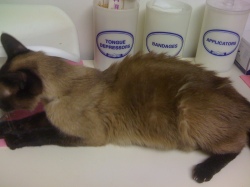
Doc Truli stood over a dehydrated, lethargic, sick-looking seal-point Siamese cat named Archie, who did not possess the willpower to meow. (Can you see the signs of cat dehydration in Archie’s picture?)
“I think he ate a lizard,” said Archie’s mom.
“That’s normal,” said Doc Truli. “What’s very concerning is the dehydration.”
“My cat is drinking so much, how could he possibly be dehydrated?” said Archie’s mom.
Dehydration in a Cat Can be Difficult to Distinguish
In the face of evidence of dehydration most people cannot believe their cat suffers dehydration, usually because the cat drinks so much water!
4 Symptoms of Dehydration in a Cat
- sunken eyes
- dry, tacky gingiva that your finger sticks to when you feel your cat’s gums
- fur standing up in clumpy shelves of gloppy unhealthiness
- glazed stare at the bathroom water spigot
“But he urinates a lot,” most cat moms insist.
(Perhaps at this point, the obviousness of the conclusion overwhelms people, and rampant guilt takes over.)
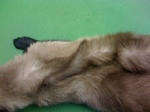
Can you see the skin never went back down?

Can you see the skin never went back down?
Veterinarians Use the Skin Turgor Test for Dehydration
The final, definitive physical test for dehydration in a cat is the skin turgor test. Turgor refers to the rigidity of the skin. Normally skin will bounce back flat just after being released from a pinch. Decreased collagen with aging will also cause a delayed bounce-back, but this is much less pronounced in cats. If you are unsure when pinching the neck skin, try the skin over the mid-back and haunches to be sure. (Do not get bit!)
Practice the Skin Turgor Test on Your Own Hand: Maybe You Can Tell How Long You Might Live!
First, practice on the back of your hand. If you are under age 50, you most likely have plenty of collagen left in your skin. So you pinch the skin on the back of your hand and notice how quickly the skin goes back down. Should be immediate!
At a recent conference focused on aging in people and pets, the presenter told the veterinarians in the audience to do this test on their own hands. The presenter said,”The longer your skin stays tented up, the less time you have left!”
Seconds later, a colleague from the front of the lecture hall said,”Oh, sh*t!” Doc Truli is happy to report the colleague is alive and well; specialists do not know everything!
Perform the Skin Turgor Test on Your Cat
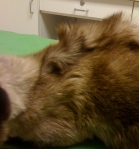
A close up of a terrible skin turgor result!
Now test your cat. Here’s how to do a skin turgor test for dehydration on your cat:

A close up of a terrible skin turgor result!
- gently pinch some skin on the back of the neck/shoulder area.
- If the skin stays up and does not go down, your cat is so severely dehydrated you have to get to a veterinarian urgently.
- If the skin takes a second or two to go down, you have to go to the vet’s because of moderate to severe dehydration.
- If your cat’s skin snaps back in place, you annoyed your cat with the test, fur is thick and shiny, and your cat is lively and happy, why are you reading this? Prepare a cup of organic green tea and leave your cat alone!
Moderate to Severe Dehydration Requires Hospital Care
Archie’s skin formed a leathery, furry brown ridge along his back. The skin never went back down.
“I can give him more water. Should I offer him wet food?” said Archie’s mom. (Most people ask this same question.)
Doc Truli said,”Archie is gravely ill. This severity of dehydration, even if the original cause was simple and fixable, has advanced. Rehydration involves much more than pouring liquid into his body.”
“How could this be, he drinks all the time,” lamented mom.
Here’s the VirtuaVet scoop on dehydrated cats who drink water like crazy:
If you cat drinks a ton of water, yet still shows symptoms of dehydration, then the fluid homeostasis of the body is not functioning properly. This means the liver, or kidneys, or brain, or a disease like diabetes mellitus, is driving your cat’s body to kick out too much water. This is unhealthy and unnatural, of course.“You cannot fix metabolic, neoplastic, or toxic dehydration by throwing more water at the problem!” says Doc Truli.
“Why Does My Cat Have to Stay in the Hospital?”
The next question almost every cat parent asks: “Oh, does he have to stay overnight?”
“Rehydration involves providing intravenous fluids slowly over time to rehydrate and balance your cat’s internal functions. The rehydration cannot occur in just minutes or hours, because the volume of fluid required to rehydrate a cat like Archie is considerable,” says Doc Truli.
Gradual Rehydration Spares Stress on the Heart
If you suddenly added several liters of blood into your veins and arteries, do you think your heart would like the extra work? No! Your heart would probably become congested and over-worked, then your lungs would fill up with the extra liquid and you would drown from congestive heart failure. Cats are the same as people.
Sample rehydration calculations:
Archie weighs 4.5kg (10lb). Archie is about 10% dehydrated. (You die around 10-12% dehydrated.). About 70% of his weight should be water. For rough estimating, he is about 0.5 kilogram short on water! Usually, Doc’s cat patients will gain about a pound of water weight after 24 hours of rehydrated. That’s like a 75 kg person (150lb) gaining about 7kg or 15 pounds! How do you think your heart would respond to an extra 7 kg/15 lbs of liquid to push around? Not good! This much rehydrated takes physical, mechanical adjustments in the body.
Rehydration Allows Rebalancing of all Bodily Functions
The liquid going into Archie’s veins needed to re-equilibrate with the interstitium between his cells.
“What?” (you might be thinking.)
(Doc Truli doesn’t talk like this in person, but you’re reading this to learn more details.)
Basically, the electrolytes — sodium, potassium, and chloride — proteins, tiny molecular factors, inflammatory chemicals, bodily waste products, etc swap out of the cells and on their way to excretion through the lymph and blood. The intravenous liquid going into Archie’s veins stays there a few minutes. A process of swapping toxic waste by-products from inside the cells to the interstitium surrounding the cells accelerates due to the infusion of intravenous liquid.
- The lymph and blood circulation carries the waste and toxic substances of the body to the liver, kidneys, spleen, lungs, and skin, where they are excreted in many forms.
- The liver produces bile to excrete toxins.
- The kidneys filter toxins out of the blood.
- The spleen grabs bacteria, parasites, and damaged, old cells out of circulation and repackages them into non-toxic proteins, or walls them off for storage.
- The lungs breathe out toxins.
- The largest organ of the body — the skin — releases toxins through sweat and excretion onto the surface of the skin.
Cellular functions improve and healing begins when intravenous fluids jump-start the complicated and natural process of healing.
If someone is visibly 10% dehydrated, you can bet this swapping out, housecleaning process will take *at least* 24 hours. Every cat differs and every disease condition sets the recovery speed individually. That’s why Archie stayed in the hospital a few days.
Helping Diagnose and Treat the Underlying Reasons for the Dehydration Allows a Return to the Home Environment
Archie the cat suffered hyperthyroidism, hypertension, and Iris classification 3 kidney insufficiency. With treatment and intravenous fluids, his renal problems improved enough to become a Grade 2, which is stable but not normal, the hyperthyroidism is controlled with medication and the hypertension resolved over two months of medication and sorting out the other problems.
Because of optimism, persistence, and financial ability, Archie continues to enjoy chasing lizards on the screened lanai porch!
Cat Dehydration Self-Quiz and Gallery

Archie: Failed Skin Turgor Test in a Cat
This is Archie. He is probably the most dehydrated cat Doc Truli has ever seen still living and breathing. Notice the skin folds after the turgor test? Most cats will have a few seconds delay on the folds going away, but they will smooth out. Archie’s folds never smoothed out!

Sammy: Ridges of neck fur= dirty or dehydrated? Labwork showed dehydration!
Sammy was a little sick. He was medium-dehydrated. About 4-6%. He got sick after eating spoiled cat food and after a night on intravenous fluids, he felt new again.
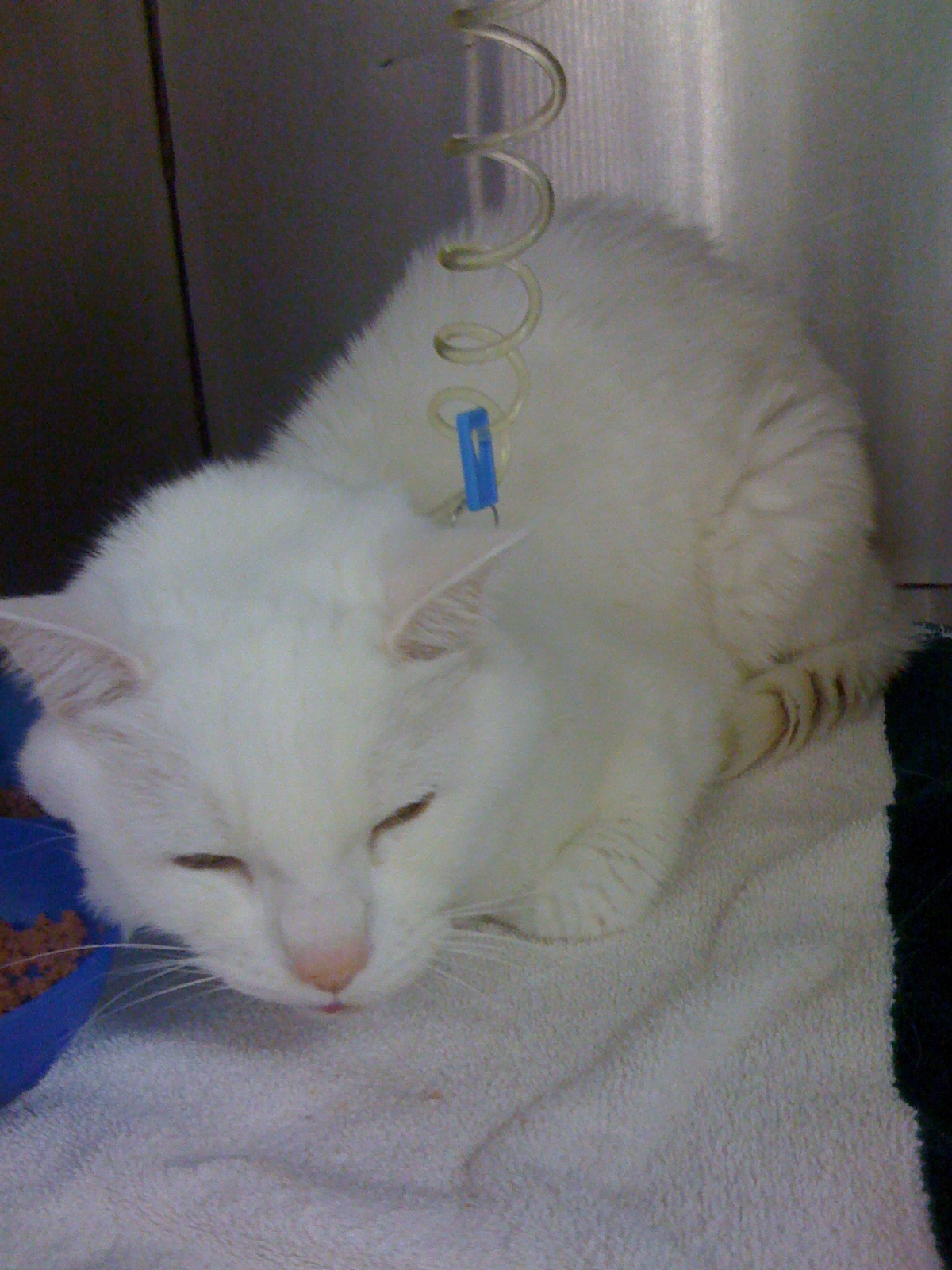
Precious suffered from kidney disease. She was very sick by the time her family realized. Notice how she sits in the hunched position that indicates pain and discomfort in cats? Plus, if you followed the twitter feed to the mouse pain article, you’ll recognize the cheek bunching and squinting that human babies, mice, and cats show when they are is discomfort or pain. With renal specific diet changes and treatment, Precious is still doing well.

Ralph: Look at how dull and sunken this cat's eyes are, compared to....
Ralph suffered liver cancer. It hit him all of a sudden and he passed away a short time after he was hospitalized. His folks chose Pawspice care, instead of invasive liver surgery which had a very poor chance of helping him live longer anyway. Doc Truli heard he had filet mignon for his last meal. Sometimes home care is the right way to go. For more information on hospice for pets, visit VirtuaVet’s pages about Pet Quality of Life.

King: Clear, plump bright eyes and smooth soft fur = well hydrated cat. Can you just see the difference?
King was a healthy, strong cat. You can see how bright and lively his eyes look compared to a dehydrated sick cat in pain.

Max: No brainer, right? Hydrated!
Doc threw this picture in there to test if you are awake! Max was a fat, sassy guy. He’s going to star in a cat obesity story one of these days. However, he’s not “stuffed,” like a stuffed toy, Max is hydrated. Notice the shiny, smooth fur that is sleek and elegant to the touch.

VirtuaCat: How about the skin behind the elbow?
Okay, the final exam on cat dehydration. This is VirtuaCat just after VirtuaVet shaved him! VirtuaCat is a Seal-Point Himalayan. Notice the folds of skin behind his elbow. Do you think he is dehydrated? If you answered “no!” you are correct.
What’s the deal? Certain breeds of cats have different skin from other cats. Especially Hairless Cats, Himalayans, Persians, and many others. VirtuaCat’s skin is softer and more flexible, with extra droopy folds behind his arms, and sagging down from his gut, even though he has never been fat! Everything is in the experience and the interpretation.
If you suspect dehydration in your cat, visit your veterinarian to be sure!
Final FAQ: IS dehydration painful?
Yes! It’s also a major cause of headaches in anyone consuming a “modern American diet.”
 "Petcare decisions are practical, ethical, moral, and spiritual decisions" -Doc Truli


 VirtuaVet
Hello Doc, perhaps you can help. I have an 8 month old kitten who for the last two months has become gradually more lethargic. He acted like he was in pain around his pelvis. We took him to the vet, who has done complete blood work, Chemistry and urinalysis. Nothing. White blood cells slightly elevated. Urine very cloudy. He drinks a lot of water, eats canned food also, but is always dehydrating. The doc said maybe a kidney infection because the urine was very smelly, but wasn’t sure. We have been treating with two broad spectrum antibiotics, not much improvement in cat or urine.
What could this be? He has been ruled out for FelV, FIV, and FIP. Please help, at end of tether! His personality has changed, he is cranky, he sleeps a lot and yowls at night. Doc says he is too young for hyperthyroidism.
Dear Liesse,
X-rays? ULtrasound bladder and kidneys? Culture of urine? Consult an Integrative doctor, especially about Traditional Chinese Veterinary Medicine Pattern diagnosis. TCVM.com has vet-finder (world-wide)
Good Luck,
Doc Truli
Do you think you could do a post on preventing dehydration? I had a scare with my two boys the other day and I had trouble sussing out the reliable information on the internet.
I took them both out to the park by the lake all day. Unfortunately it got hotter than we expected. Kibbles is a large, long haired ragdoll. I think he was overheated when we got there. I though he was nervous of the car. I gave him a small nibble of a calming treat and it seemed to help. When we got there he hung out in the shade under the picnic table, I donate a cool pack from my friend cool vest (that he has to wear) and Kibbles claimed it. I gave him some wet food, but couldn’t get either of them to drink.
When we got back from the lake, they still wouldn’t drink. Kibbles looked worse. He wouldn’t sit still for a skin test. I offered him water, eh wouldn’t drink. I gave him some wet food and scored the Internets. He’s old, so I was really worried. He usually drinks a lot of water. I’ve been told they need something like an ounce of water per pound of body weight and he weighs 25-30 lbs.
I drained a large can of chicken packed in water and diluted the liquid by half with water. I didn’t have anything else. I figured it would have some electrolytes in it (since its essentially weak plain broth) and it had some salt. I offered them two ounces of this mixture every hour or two. Basically as much as they’d drink on their own. Last night they drank almost all I gave them. In the morning they wouldn’t touch it or their water.
So this morning I made a slurry with the chicken liquid I made and some wet food. They inhaled it. They’re both doing fine now, bouncing around light in their eyes and their skin is springy like it should be. But they gave me a scare and none of the vets were open yesterday or today….and I just moved them up here so I don’t have a Vet I trust yet.
So theirs the story, congrats if you read it. I’d appreciate it if you would write about your suggestions, especially for when out with cats that won’t drink.
Wow! That’s an amazing story. Cats are territorial animals and rarely enjoy leaving their house or yard. (I have met cats that like to travel, but the territory is usually their RV). Once your Ragdoll was out at the lake, they did not drink because they did not wish to. My cat would be panicked in that situation. It sounds like a very stressful day for a cat and I would not recommend taking cats on outings the way you might take a dog. The vast majority of cats will not enjoy it. They will stress out. Not drink. And then could become very sick. (Kind of like I feel if someone makes me go to the beach for the day.)
Thank you for sharing. I’m certain there are other people out there that thought maybe their cat wold enjoy a family outing when nothing could be farther from the truth.
-Doc Truli
My 2.5 yr old male abyssinian cat gets stressed and starts using the kitty litter a lot. He was diagnosed 2 days ago with feline idiopathic cystitis and was given SQ fluids because he wouldn’t eat or drink and he had vomited a few times. I brought him home on Friday night and he hasn’t eaten since then (now is Sunday afternoon). He drank a few sips yesterday and I gave him some water in a syringe (5-10 ml). Yesterday he passed a number of clear mucous stools. He is not obstructed and no crystals in urine. He is on Prazosin and a little valium. Today he has not urinated all day, is lethargic, no vomiting, not eating or drinking. I gave him 40 ml water with some sugar and salt in it by syringe and some Wellness wet food mixed with water via syringe. He is not too perky. My vet hasn’t called back. Is it OK to continue with this plan and see the vet tomorrow?
Actually, he passed clear mucous urine not stools.
My 21/2yr old Calico, tabby and tortie mix cat was recently diagnosed with potential early stage liver failure/fatty liver. She was in the animal hospital for 2 days and I now have 2 antibiotics to give her 2x a day, liver protectant, 150ml iv fluids 1x day, appetite stimulants and syringe feeding her. She is still jaundice, but what I thought was her getting better I’m not so sure. She is going to her water bowls now (as where she wasn’t going at all) but won’t drink. she is just sitting and staring into her bowl. I am very concerned. I read that we could potentially heal her by doing this, but treatment can last 3-6weeks. I am just not sure if I can afford any more vet bills as I have 4 kids and it’s the holiday season. I am doing all that I can. My kids and myself are seriously attached to her. I am trying to stay positive and hopeful. Please, I seriously need some helpful insight.
Our 14 week old kitten was neutered a month ago. Shortly after coming home I noticed his stools were very foul. I don’t know if you’ve ever heard of c-diff in humans? But that is what it smells like. I thought maybe it was because of constapation from the surgery. So I just decided to watch him. It has progressively gotten worse. His gas is terrible. Clears a room terrible. Now he has diarrehea that isn’t making it to the litterbox. It’s not every stool but most. He has no issues urinating in the litterbox. That is what is confusing me. Since yesterday he has started to get lethargic and his eyes seem different. (I don’t know if it is a change in facial features as he is growing or if it is because he is dehydrated?) I did the neck test thing and there is a slight delay when compared to my other cats, but nothing too bad. I contacted the clinic that he had his neuter done at and they are saying to take him into a full service vet. Which I intend to. (Its Sunday night right now) is it possible he picked something up from the clinic?
I doubt he picked something up.
At 14 weeks, he still needs deworming fir hookworms a roundworms every 2-3 weeks.
Also, we see many kittens get a stress-type imbalance in their gut flora and have diarrhea that is difficult and time -consuming to treat.
Usually, we do a fecal and deworm and treat dehydration and and bacterial overgrowth. We can also replace gut flora and sometimes vitamin b12 is needed (injections.)
We rarely see clostridium. Possible, though.
Plus, consider how young and small your kitten is. Slight dehydration or a few days of diarrhea can kill a kitten. For our readers, do not let a kitten have diarrhea for more than a day or two without professional evaluation.
I tell my post-op cases, 1-2 soft poops may be from the anesthesia. Beyond that, call for help.
Good luck at the vet’s on Monday. I hope your kitten recovers quickly.
Yours,
Doc Truli
My 14 year old, 6.2 kilo cat has been getting progressively lethargic over the last week. To the point that she has not eaten or drank in the last 2 days, nor moved more than a 2 foot radius. She has lost a significant amount of weight this week i think.She has peed on my carpet, 2 feet from her favourite resting spot. We took her to the vet last night, and he said she is dehydrated but could not run any blood tests because the results wouldn’t be in until Tuesday. She seemed to be preparing us for the worst. Her blood sugar was low but she said it was because of dehydration. We brought her home and have been bringing food and water to her. She has been drinking, long and belaboured drinks. Will not touch food. She peed his morning on the carpet again, and a small poop that was wet and dark-no more than one little turd. I don’t know if i should take her to the ER vet, or continue to nurse her at home. I think she will be happier at home? She is still lethargic, and her eyes are dark and glazed like yesterday. When she moves her walk is belaboured. Any advise?
I bet the ER vet has in-house blood work machine so you don’t have to wait for answers. I’d take her and find out.
You don’t have to leave her there of you don’t want to.
The thing you said about sugar being low be because she’s dehydrated makes no sense medically. I’m guessing you heard that one wrong.
Antibiotics? Fluids? Special food?
I’d go to the ER doctor if I were you.
Thanks for reaching out.
-Doc Truli
We are at the ER vet now, just in the waiting room. They feel she is breathing very heavily and placed her on oxygen to see if that helps. They are talking about congenitive heart problems as a possibility. They want to do an X-ray first and then do the bloodwork. Hoping for a positive outcome. Thanks for you response!
I’m so happy you found some help.
This post was so helpful! I’m really worried about my little Mira, but dehydration was never on my radar because she’s been chugging so much water recently. She is a shorthair tuxedo and only two years old, but she was found in a dumpster (likely the runt of the litter) with a traumatic spinal injury. She can walk fine, but her hind legs aren’t perfect and she has a hunchback. She also dribbles dark pee anywhere she sleeps. Normally she vomits after eating, but recently adding probiotics to her top-of-the-line food almost eliminated that. The vet has always said this is all 100% ok, so the probiotics were me taking matters into my own hands. However, lately she hasn’t moved from the same sleeping spot almost at all. We have been battling a flea issue, but I didn’t think that was serious? Just this morning I was petting her and she started … jerking her head forward and making a funny sound. I will take her to the vet asap, but they have never been very helpful in my experience 😦 I would be eternally grateful for any insight you could give!
She sure needs a good veterinarian. If your vets have not been helpful, go somewhere else. If you are in the US, you can get a referral from the American Holistic Veterinary Medical Association website.
Thanks for telling us about your kitty cat. What’s her name?
-Doc Truli
Thank you for responding! Her name is Mira. I made an appt. with a different vet today, but I might check out VCA SouthPaws (a holistic center nearby). I’m starting to wonder if the fleas gave her worms. I thought she was gaining weight from the probiotics, since she usually hovers at a measly 5-6 lbs, but maybe she has a stomach full of worms …. Everyone told me to use tea tree oil, but I read it causes liver toxicity in felines! I am really worried about her.
My cat is 11 years old and was diagnosed with a cancer in the lymphnodes in her intestines 2 days ago. She went from an 8kg cat down to 4.5kg in a week and the vet said she was very sick. We took a biopsy to find out how aggressive her cancer was and the results came back that she was cancer free and instead her body had produced too many eosinophils which caused her lympnodes to swell. The vet gave her a steroid injection to stop more cells being produced at that rate amd hoped she would bounce back yesterday. Last night she perked up quite a bit and showed interest in food however today she has slowed down a bit again and keeps sitting with her nose to the floor. We’ve had to syringe feed her liquid food and water. She also doesnt seem to shut her eyes when shes led down, she simply stares. do you know why this could be?
She sounds like she’s either feeling “out of it” or focused inward, like she’s in pain somewhere.
There’s a report from the US (I think it was in JAVMA years ago) about ehrlichis canis infection in a dog causing lymph node enlargement that mimicked lymphoma.
Even if the specialists decided she does not have lymphoma, thickened intestines can still not work right. Your vet needs to help you treat potential gastric ulcers and consider motility of the gut. There are treatments to help either situation. I’d suspect your cat is at risk for both ulcers and ileus (lack of peristalsis). Why don’t you return to your vet for more supportive care?
Is there an easy way of home-making a feline rehydration fluid? For example, I know you can make one for humans with 8 spoons of sugar and 1 of salt in 1 litre of water, but I don’t know if this balance is OK for cats.
My Sirocco (a 15 year old Birman) never drinks (this is an old habit of his) and has begun, in the last year or so, to dehydrate very easily. He has been tested for everything under the sun, including a rather expensive specialist abdominal ultrasound, and he comes up healthy; just dehydratey.
These days I keep rehydration fluid at home and syringe it into his mouth in small regular doses if I notice he’s started to get dehydrated, but this is getting rather expensive!
Doc,
I am worried about my little girl, yes this is a cat that is just what we call her. She is 5 years old and weighs 15 lbs. In Oct. we put her on the healthy weight food to help with that. A week ago she got her yearly shots and has always been healthy. 3 days ago she ate a good size lizard, I have no idea what kind but I know she has eaten this kind before with no problem. Since then she has not eaten or drank like she should. She is taking a bit or two of food, dry food, in the last 2 days, and had almost no water. She does eat her soft treats with no problem. I have just started today giving her water via syringe. I don’t have a lot of extra money to take her to a vet. So I will take any help you can give. Thanks in advance.
Dianna and the little girl.
Also she is not using the litter box at all from what I can tell. Thanks again.
Whoa, Dianna,
I suggest you at least invest in a physical exam. You could promise yourself you will ask for a problem list, a diagnosis or differential list and a written estimate organized in order of priority with diagnostic tests first and symptomatic treatments next. She might really be sick. Plus, if she goes too long without eating, she could switch over into hepatic lipidosis. Very expensive, very scary liver failure.
Yours,
-Doc Truli
Thanks so much for your help. I am new to Central FL, so I have to find a new Vet.
Hi doc,
My 8yo cat Twinkie did not eat over the past weekend, so I brought her to the vet Mon morning. They did a CBC and “17 point” metabolic panel (?) on her, which showed slightly elevated ALT and AST (both were in the low 200’s, not sure if that is “slight” elevation, but that is what the vet said). All other tests were normal, no fever, but the vet said Twinkie was “a little” dehydrated.
I expected this because Twinkie was vomiting yellow bile nightly over the weekend, consistently between 2am and 4am.
So the vet gave her a dose of subQ B12 and fluids that he said will help rehydrate her and stimulate her appetite. Also gave her an injectible dose of Cerenia for the vomiting.
He prescribed her daily Cerenia and Denamarin, as well as twice daily Clavamox. Clavamox maybe prescribed because I told him that I had noticed “stuffy” nose breathing when I put food or water in front of Twinkie, and had spent a good 15 minutes picking my cat’s boogers the night before to help her smell better! (The things we do for love! Though I’m pretty sure Twinkie thought she was being abused.)
Now I have brought her hom for about 24 hours, and have kept by her side constantly. I managed to get her to eat abut 15-20 cat treats, which is encouraging, but she will not eat food. She despises wet food, and hates it even more if I put water on her kibble. Hates all human food, including salmon and tuna; she always has hated them, but I tried both over the weekend just to see if she changed her mind – no luck.
She will drink water, and has done so 5-6 times since we got home. I just offer her fresh water in a shallow glass bowl as often as she is awake, then for about 15-20 minutes I will sit next to her while she drinks. When she stops drinking and looks up at me, I will take the bowl away for a few seconds, then set it infront of her again, and she usually resumes drinking. I continue this until she refuses to drink more.
HELP, Doc! She still won’t eat much, but most disturbingly: SHE HAS NOT URINATED IN MORE THAN 24 HOURS! I’m bringing her back to the vet tomorrow, but am still very concerned. When I do the turgor test, the skin returns to normal, but it takes about 5-8 seconds. I’m not sure if this is terrible, or acceptable.
The vet did say that her kidney functions were normal, as well as any pancreatic functions, but that he suspected that pancreatitis was at play. That pancreatitis can still show normal levels in the tests we had done. But this shouldn’t affect her urine output, right?
May be of note, he said her lungs are clear; he squished on her abdomen quite a bit, and didn’t find any abnormality there; looked in her mouth a while (including under her tongue? What does that indicate?), and didn’t mention anything of note there either, except dehydration, I guess.
Please help me – I don’t understand why if all she has is elevated ALT and AST, why will shestill not eat? The B12 ddidn’t seem to do much. And more importantly, if she is drinking water, why will she not pee? I try taking her to the litterbox repeatedly, and nothing, she just hops right out! I wouldn’t even care if she peed on my floor, or my bed, or hell, even if she peed on my pillow or my lap! I just want her to pee so that I know I don’t have a broken cat!
Thanks so much in advance,
Lauren
Checking under tongue
1) check for string caught
2) part of thorough exam
Liver enzymes
Indicate stress on the liver, but but what is causing it
Stuffy nose
Can she smell her food?
If not, she will not eat
Pancreatitis
Can mess up many regulated functions in the body
Skin turgor
Sounds like she’s dehydrated-she will pee much less to preserve fluids inside her body. That’s a sign of healthy kidneys.
Did she have x-rays and ultrasound?
Supportive care may include iv fluids in hospital. It can be expensive. You may have to compromise and do SQ (subcutaneous) fluids at home. (Vet can teach you)
She may benefit from nebulization to clear out her nose and prescription appetite stimulants (ask your vet)
Good luck!
-Doc Truli
Thanks, Doc Truli for responding so quickly! As you can imagine, I’m terribly stressed and constantly on the verge of tears, so any info from a professional is comforting.
I suspect her liver is stressed because she has not been eating. And maybe she’s not eating because she can’t smell her food. But would a cat really starve itself because of a sinus infection or URI?
She didn’t have any imaging done, I will ask the vet if he thinks they would be helpful tomorrow, as well as the nebulizer and appetite stimulants.
Are there other things that you could recommend that may encourage her to eat? And do you think that force feeding is ok? I would wait until the vet recommended that I do so, but I’m concerned that would make Twinkie even more averse to food if she associates meals with me shoving a turkey baster down her throat. She’s already pretty annoyed with me over the Clavamox suspension. (Funny, after I gave her the Clavamox, I found your article on drooling after medicine. It made me feel much better to know that most of it probably did get in her system rather than dribbled on the floor!)
You seem like an awesome vet, and I’m really grateful that you have this blog. You have no idea how comforting it really is that you’re here and willing to give such knowledgeable advice/information to those of us with babies in trouble!
I will let you know how Twinkie is doing. Hopefully I will be posting happy news soon, rather than long stressful queries.
Thanks again, you really are the best!
Lauren
This is one of the best blogs i have seen. I wonder if you could help me. I recently got my lovely wee furball ( 5 days ago) he is 8/9 weeks old and half persian. When we got him he seemed fine, he is very active for 1-2 hours, then has a catnap. Allows you to handle him etc generally seems a happy kitty. His poops, however , are causing me concern. He has had loose stools for nearly 32 hours. Eating and drinking normally ( a bit annoyed seeing as he cant get his cat milk). We did leave iams out for him which was not what the breeder was feeding him. His stools have gone from very yellow to a dark brown since stopping the iams but are still soft. Does my wee pal need a vet?
Dear Jem,
He sure does need a vet. Liquid diarrhea can be debilitating. It can also be very tricky to resolve. Your vet will guide you. It is rather urgent, the wee one could become very ill if you delay.
Good luck,
Doc Truli
Thanks doc!
I had my Rafiki at the vet today, he is apparantly fine! I even took a stool sample just to show the vet exactly why i was concerned. He gave him a probiotic medicine for his tummy, put him on a plain diet food ( Fiki is NOT impressed) and a worming powder. He isnt running to the loo all the time and his stool had started to form again although still quite soft. Thank you for your reply
Thank you, Doc Truli. I searched through this website to see if my 19 year old cat was perhaps dehydrated or needed to go to the vet. I took her today to see him, and I realized I did need to let her go. Thank you for all the helpful information you give to pet owners on this site, and thank you for how compassionate you are.
How did the appointment go?
The vet was wonderful. He took a blood culture and told me her kidneys were failing. He said that I could try keeping her in the hospital over the weekend and pumping her with fluids to see how she would do– but he also said that at her age, she would have another episode like this last one in time. She had lost two pounds in the last two months, and her levels were pretty high. I knew it was time to let her go. I am thankful for all the time I had with her. She was the best cat in the whole world. Tears… but thankful for the gift she was to me.
How long is too long for a kitten to not drink?
On Thursday evening we caught a semi-feral kitten (probably 8 to 10 weeks) with the help of a professional. The kitten was a part of an out-of-control colony with a human caretaker.
Since being brought home the kitten has been very timid and scared, which I completely expected. I am trying to spend as much time in the room as possible, and keeping an eye on it without getting too close and scaring it (which I think is the right way to do things, but this is honestly my first non-humanised cat; the other two were abandoned and hand reared). It likes to find places to hide and watch me working.
The part that is worrying me is that the kitten isn’t eating or drinking anything as far as I can tell. It’s been 36 hours now and it’s a little scary. There is water available (gonna put a second bowl out just in case) but how long can it go before I should panic properly? I don’t want to have to catch the kitten to check it’s skin/ give it water directly unless it is necessary.
It did also get its teeth caught on the wire mesh on the cage for a short while. I don’t think it got hurt though. It will be going to our local vet early next week as well for a normal checkup.
I don’t know. But I’ve never heard of a healthy kitten dehydrating itself on purpose. However, maybe the kitten doesn’t recognize the water as water. Make sure there’s wet food and maybe some meat. You know, different forms of the food to tempt the little one.
Thanks for the response. The guy who helped capture and websites seem to say that up to 72 hours is normal, but I still worry. Kitten isn’t eating as far as I know, but the room is starting to smell a little sand-tray like so the little thing might be drinking on the quiet.
if I don’t see anything by tomorrow gonna catch it and check him/her out just to be safe. I have also had to dunk a kitten’s paw in water before to get it to understand how the bowl system worked.
From all us anxious and desperate dog owners & cat-trained humans thank you for this blog and all the useful information on it.
Thanks for the feedback, Mike. Keep Savin’ ungrateful kitties!
Just an update.
We hit the 72 hour mark and I figured it was best to check the little thing physically just to be on the safe side.
After two humans played cat and mouse for half an hour we caught the kitten in a towel, got bitten and scratched but were able to give it a once over. Kitten definitely seems to be in good health (little black blur most of the time) and doesn’t show any signs of dehydration. I do think he was holding in his pee though since the towel got wet as soon as he got caught.
So apart from a small setback in building trust with him everything seems good.
I hope this little adventure helps anyone else who adopts one of these partially stray cats.
I recently moved almost a week ago and since moving my 2 1/2 year old silver and black tabby named Bullet hasn’t really eaten or drank much. He has had maybe 2 small handfuls of dry kitten food, a couple sips of water, and a couple nibbles of wet food. He doesn’t come out from under the bed much unless I take him out to snuggle and he has yet to use the bathroom and I’m worried he might make himself sick. He is showing no signs of dehydration (which is what I was worried about) other than depression but I thought it was just because we moved out of a house where there were 3 other cats and a dog and now he is the only animal (other than the nocturnal hedgehog). Is there anything I can do to coax him to eat or drink? maybe use the litter box? I am just trying to prevent him from getting sick as well as adjusting him to the new home.
Cats do usually hate to move. Look up Feliway pheromone treatment.
Hi! My cat is very active indoor outdoor kitty, I kissed her goodbye this morning and this evening when I came home she was in the exact same spot! (Very odd) She is very lethargic and won’t eat or drink and the hair on her neck is standing up a little. She also feels Warner than usual! Could it be dehydration any advice would be greatly appreciated!!!!
Dear Amanda,
You are describing signs of a sick cat. I would take her to the vet’s and see what is wrong.
Good Luck! Let us know how it goes.
-Doc Truli
My cat started over grooming last summer and I thought it was because it was so hot. I did get a new roommate who wanted very much for her to like him, but, as far as I know, did not try to harm her.
Now, almost a year later, my cat’s bare tummy is now a bare abdomen and she’s starting on the sides. The backs of her legs are also bare. There is a ridge of fur on her back that’s begun recently to show. She looks somewhat smaller, though she doesn’t look ill (coat still soft, eyes bright, etc.) She is 12 y.o.
I was locking her in my bedroom with food, water, and a litter box while I’m at work, but I now allow her to leave the room and that hasn’t helped.
She does not appear to be dehydrated at all. She eats and drinks well. Hard to really keep track because there is still food in the bedroom and food in the kitchen for her at all times. Please let me know if you have any experience with this.
Yes. Sounds like she needs to see the vet. Plus, she does not have environmental enrichment. If she must stay in a small place, then be sure she has a cat tree or other three-dimensional spaces to explore and own. Does she have nice views? Does she have activity toys to keep her engaged? Do you play with her for 20 minutes at the same time every day so she has something to look forward to? Plus, take her for a check-up.
-Doc Truli
my cat is about 4months old. he was a barn cat, but now a house cat. he recently has stopped eating and drinking. took him to the vet yesterday and was told he is dehydrated, but unsure of anything else. prescribed him an antibiotic just in case. he also had pretty bad ear mites, but his ears have been cleaned. there could still be and ear infection, so i am not sure if this is causing things to be so bad for him. he tends to stare off into space and his eyes seem to be dialated in the light. he also seems to have some sort of painful muscle spasms randomly. i’ve been manually giving him water and food. i don’t know if i should take him back to the vet or be doing something different of if there is no hope or if i need to wait it out for the meds and water to work it,s magic. he is a lovely kitten and don’t want to lose him. help me!
Dear Kassy,
I’m sorry to hear your kitty is feeling sick. You may need to invest in some laboratory testing to find out what ails your kitty. I would recommend you take him back to your vet and ask what tests he needs. If you cannot afford them, then at least get specific nursing and supportive care advice from your veterinarian.
Yours,
Doc Truli
I have to say this is one of the best veterinary info blogs I have come across. Well done and thank you so much.
Thank you so much.
Great web site. I have a 2 yr/7mos old, altered female, strictly indoor kitty. She has been tested for Feleuk/FIV and tested negative. I use a home vet who has a mobile clinic and performs surgeries in my driveway. He is due back tomorrow. I am going to ask him to re-run the Feleuk/FIV test on the off chance that I got a false negative. My little 7# female has been suffering with an ongoing bladder infection for the past 4 weeks which is only one of the reasons my vet is returning tomorrow. He has twice given her an injectible type of antibiotic that is supposedly good for two weeks. I’m concerned that her bladder infection has not cleared up yet but it has improved with the antibiotic. My bigger concern however is that three times over the past year, my little female has become lethargic looking, sits in a hunched position with squinted eyes which may indicate pain or discomfort, she won’t eat or drink or go to the litter box and when I pick her up, she is totally limp in my arms. She typically struggles when I pick her up. This will last for approximately 48 hours. The first time it occurred, I brought her in to see a vet down the road. The vet checked her, said she was fine and asked if anything had changed at home. I told her my daughter had just recently moved back home. She told me this was probably what the problem was. The 2nd time it occurred, my home vet had just come in and did annuals on my two older, male cats — exams plus dentals. They smelled funny and were acting strange due to the sedation effects so I assumed my little female again was just reacting to these things, i.e., didn’t recognize her “brothers” and was afraid of them. However, she had another episode like this 1.5 weeks ago which was caused by absolutely nothing as far as I could tell. I now know that something is definitely wrong with my little cat, that she is not merely sensitive. I’ve spoken with my vet about this and he tells me that a cat that goes 48 hours without food or water is in grave danger of dehydration. I now feel awful that perhaps her organs may have been damaged by past episodes of dehydration. My vet says he is stumped as she is not vomiting and does not have diarrhea. He is due back tomorrow and will recheck her urine for bacteria, blood, etcetera and is also going to run typical blood work on her, CBC I suppose, as well as do kidney and liver blood work on her. I love my little cat dearly and am praying my vet can find the reason for these episodes. I cannot allow her to dehydrate when one occurs again. I am hoping there is nothing seriously wrong with her as I have do resources however they are not endless and I do not have a fortune to spend on my little cat as some people do their pets. Any help would be appreciated. Thanks for your time in this matter. Sherry
Dear Sherry Ann,
Your vet will know where best to put your financial resources toward helping your kitty. But, I do have an idea based on your story. Even without any vomiting or diarrhea, she could be suffering bouts of chronic pancreatitis. It ca be very difficult to diagnose. In America, there”s a snap test called an fPLI that is a good screening test. If it says “no,” then it is likely “no.” If it says “yes,” especially during one of the times she feels sick, then it is likely “yes.” There are also expensive pancreatitis tests called (B12, folate, TLI, PLI). It is difficult for me to recommend spending a few hundred dollars (US) without any outward signs of gastrointestinal disease. Yet, I still feel the gut is the foundatio of health and energy. It seems like her gut is suffering periodic bouts of illness.
We would all be very interested in your journey and (hopefully) diagnosis.
Plus, do not worry too much about the dehydration. Professional athletes get massively dehydrated regularly and their organs do not suffer permanent damage (think Lance Armstrong in the 2003 Tour de France individual time trial.) Just focus on your kitty from today forward.
Yours,
Doc Truli
My Cat Ziggy has stopped eating for the last 4 days. He seems like he wants to eat, but everytime he gets close to the food, he starts to chew and move his head side to side (almost like there is something there that is coming up and going back down). I have tried hairball paste and in the fist 2 days a couple small hairballs came up, but since then…..nothing. I put some organic cat grass out for him, that he chews on (also trying to get out whatever is in there) and he throws that up with white foamy stuff. I am taking him to the vet tomorrow because I have been unsuccessful trying to relieve him. He drinks small amounts of water (but only from the bathtub tap). What do you think is wrong with him? Does he have something logged in his throat? He is breathing okay and sleeping lots, but is definitely off from his usual self. I’m just very worried for him!
Dear Kristy,
You are describing “non-specific” signs of disease. There are over 50 different diseases that could fit “not eating” and “vomiting.” It sounds extreme when it lasts more than 1-2 days. It sounds like Ziggy needs a doctor.
Yours,
Doc Truli
Hi, my cat is a male 8 years old. 2 days ago he wasnt drinking water that much, now today he cant even move without meowing in pain. He tries and he can but his 2 front paws hurt….or at least he cant use them, it isnt broken at least i dont think becasue he was able to extend his claws and grab onto my finger…all he does is meow at me when i talk to him and i know he is in pain. I have saline and im doing it in short periods, but he doesnt seem to be getting any better i literally have no money, i am a single parent with 2 kids, and i wish there was something else i could do. i am forcing him to eat little by little, but do you have any other suggestions for me?? thanks!
Hi Britney. I know it’s been a month since you left that comment but I wanted to give you a few suggestions that may help you help your kitty.
If you need money to take him to a vet, then try opening up a Chip In http://www.chipin.com/ caring people donate money to your cause.
You can try posting it on Pet Pardens (lots of caring people go there and use chip in) you can create a page for your kitty and just state that it’s to get him help.
Also for future protection for your kitty, try PetPlan (Petplane.com. my policy #ALZ5000455 as a referral)pet insurance, it’s around $10 a month and their covered for med bills and other expenses.
Best of luck to you and your kitty.
Hi,
What happened to Archie?
Archie’s kidney function stabilized for a few months. Eventually, he grew too weak and mom brought him to Doc Truli for his final transition out of this life. Archie’s mom was elated for the extra, good quality time with her best friend.
-Doc Truli
My cat was recently diagnosed with stage 4 kidney failure. The vet also believes she has lymphoma in her kideny. She has been put on all kinds of medications and recently was prescribed sub q fluids twice a week. I have given her weekly dose of sub q’s last night and this morning I noticed what look like saggy skin in her armpit area. When I gave her her dose today it got larger. Is this the fluids and will it absorb evevtualy or do I need to take her back to the vet.
Dear Nicole,
Take her back to the vet. Here’s why. That pocket is probably the fluids from the night before (or something unusual that I can’t discern over the internet). So either she doesn’t need that much fluids, or something is very wrong and she is not using the fluids you are giving her. Your veterinarian can assess which is the case and help your cat considerably.
Good Luck,
Doc Truli
Thanks Dr. Truli for the good info. I struggle with this issue as my cat is going through chemo and is very furry. At one point, I brought her in and she was at 7.5 dehydrated. I give sub-q on my own now, so she hasn’t been dehydrated since.
R. Graves
Thanks for posting this very valuable piece of information. My 2 year old female kitty has been diagnosed with advanced stage, effusive FIP. I found out that sending her to the vet for Sub-Q fluid infusion somewhat re-energizes her into mild remission.
She is drinking on her own, but apparently not enough to combat her severe dehydration. My cat now looks like poor Ralph in one of the photos above, only much worse. She is now on Baytril antibiotics, a small dose of prednisone and ranitidine to reduce her nausea and inappetance.
My cat is strong willed but unfortunately her organs are failing her. I would wet her fur with some surgical alcohol (70% volume) to cool her down whenever her temps are above the norm. I do have some leftover meloxicam in case she needs it badly for high fever, but restrained from giving her for fear of damaging her kidneys any further.
I’m sorry to hear about your kitty’s illness.
For appetite stimulation and as an anti-depressant, ask your veterinarian about mirtazipine. It is cleared through the liver, and FIP reduces all organ functions, and in an unpredictable individual way, but the mirtazipine is a good appetite stimulant and an anti-depressant. It could help her feel better. I also use injectable midazolam for appetite stimulation in cats. It’s related to valium and gives cats the munchies. Unfortunately, no pill form, but sometimes you can learn to give the doses at home.
Yours,
Doc Truli
Dear Doc Truli, here’s my dilemma:
I’ve resigned to my cat’s inevitable fate and accepted the fact that contemporary veterinary medicine cannot cure FIP. However it is quality palliative care that I’m concerned about.
My vet is adamant against any kind of benzodiazepine, citing possible impairment of kidney or liver functions, especially in my cat’s condition.
I asked for a liver enzyme count but she said that her CBC procedure did not involve liver enzyme diagnosis. She is a fairly young VMD (in her mid 20s) and I sensed that she had little experience with giving even diazepam as an appetite stimulant. (I know this for sure, as I had been on diazepam before and does increase my appetite).
Suffice to say, if she wouldn’t give something as “mild” as diazepam, midazolam would would be totally out of the question. I doubt the animal hospital carries midazolam anyway.
I have tried giving my cat cyproheptadine/L-lysine drops to increase her appetite but stopped upon the advice of the vet. I noted all the signs of nausea in my cat but so far she has never vomited bile.
Force feeding Hill’s A/D prescription formula is something that neither my kitty or I enjoy. In fact, feeding time has become a very stressful event!
I have watched her eat flaked white tuna on a few occasions but stopped after the first few sips/mouthful. Probably due to her discomfort and nausea. What can I do? I have alprazolam (Xanax) at my disposal but don’t know the right dosage to give to my cat.
Would alprazolam be a good substitute for diazepam in cats? I’ve sneaked in about 0.25mg into her food once and noted no ill effects (none yet so far). But I observed that on the same day, she developed an interest in the same food that she used to love.
Currently, my Baby Kat is on the following:
– Hill’s A/D prescription diet (sometimes mixed with tuna for flavor)
– Felovite with Taurine multi-vitamin oral paste
– Baytril antibiotic for the blood parasites
– Prednisone corticosteroid as an anti-inflammatory agent
– Ranitidine for her acid reflux/nausea
I know about Remeron (mirtazapine) as I’ve been prescribed them before for my own illness, (currently on Lamictal and Cymbalta a.k.a duolexetine).
If I were to ask for mirtazapine, midazolam or diazepam for my cat’s inappetance , what would the safest dosage be? My cat weighs under 4 kgs at the last weigh-in at the regular vet’s.
thanking you in advance!
Q.
Q-
I do not know your cat’s condition, because I’m not there. If your vet feels a drug is contraindicated, perhaps it is!
Midazolam is not diazepam. Diazepam has been shown to cause idiosyncratic irreversible liver necrosis in cats. No one knows why or which cats. Midazolam has not done this. I use midazolam as an anti-anxiety med with almost every cat surgery I have done for the past ten years. It makes the cats so munchy, they will eat right after surgery if I give them a chance! It is super short acting in most cats, so the bowl of food must be right under their noses after the shot. You are following your veterinarian’s guidance, which is great. I can tell you, I never used midazolam for cats until I was about 3 years out of school and called the pharmacology professors at several North American veterinary colleges until I felt comfortable trying the midazolam.
The alprazolam you’ve given could cause liver and kidney damage, too. (All drugs have unwanted side effects with the wanted effects; it’s a trade-off). By giving your cat meds without your vet’s advice, you are experimenting on your kitty. Do you want to do that? BTW Alprazolam is not known to have any appetite stimulant effects in cats.
I can’t ethically give you medication doses for a cat who is not directly my patient! (That’s why you can’t find doses on the internet.) You could really damage your kitty’s quality of life that way. Your veterinarian has specialists at her fingertips. If you are gently persistent in your concerns for your kitty’s appetite and keep questioning whether or not everything is done for her comfort, your vet can keep researching and gathering ideas for how to best help your kitty.
Try not to become adversarial with your veterinarian, it doesn’t help anybody. FIP is a terrible disease. There is not one “right” course of action. The regimen you listed above sounds good. There was one other thing I thought of that could help appetite and digestive health, Vitamin B12 injections. Veterinarians have started adding B12 injections to very sick kitties’ treatment and it helps them feel better. Make no mistake, however, FIP is vicious. Just do the best you can!
Good Luck!
Doc Truli
Thank you for the link! I hope VirtuaVet helps the kitties out there!
-Doc Truli